Share your journey
We would like to thank Eastern Pacific Shipping for sharing their story. We would love to hear from our other Members about their decarbonisation journey. Please contact Mark Smith to find out more.
This is archived. This content was originally published on nepia.com or standard-club.com and will no longer be updated. Please check our live news area for all our latest updates.

The voyage to decarbonisation presents organisations within the maritime community many unique challenges, where no ‘one size fits all’ solution exists. In the spirit of mutuality, North Member Eastern Pacific Shipping (EPS) shares with us their experiences with dual-fuel engine vessels and ensuring the necessary crew training.
Dual fuel engines allow ships to be powered by either LNG or liquid marine fuels including, but not limited to biofuels, distillates, and residual fuels. The switch between fuels is achieved without loss of speed or power. This gives operators greater flexibility with bunker procurement.
LNG is a transitionary, marine fuel which helps to reduce the carbon footprint per ton-mile of cargo transported. It’s a step in the right direction towards the IMO goal of reduced emissions. This positions EPS as a transportation provider of choice in the shipping industry whilst attracting charterers.
The 110,000dwt, ABS-classed Atlantic Jade was delivered in the first half of 2022. It is a ‘Long Range 2’ (LR2) LNG-fuelled tanker capable of sailing up to 18,000 miles in laden condition. The vessel has two ‘Type-C’ LNG fuel tanks, each with a volume of approximately 2,300 cubic metres.
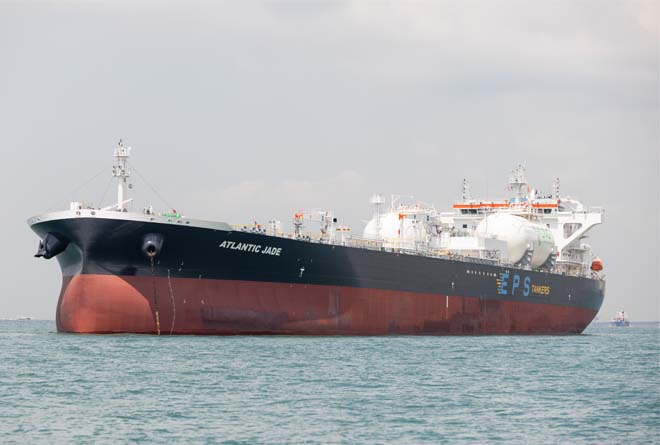
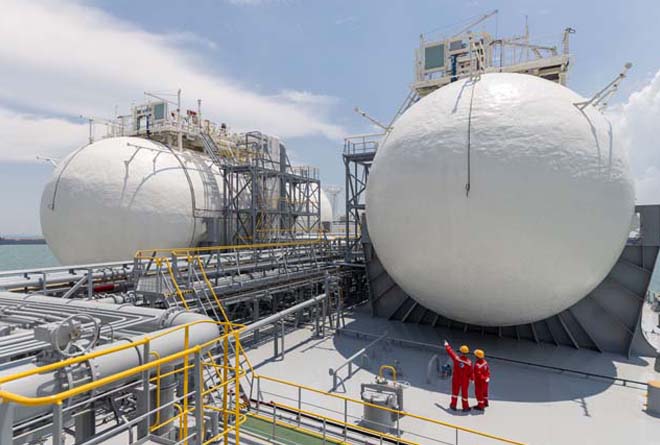
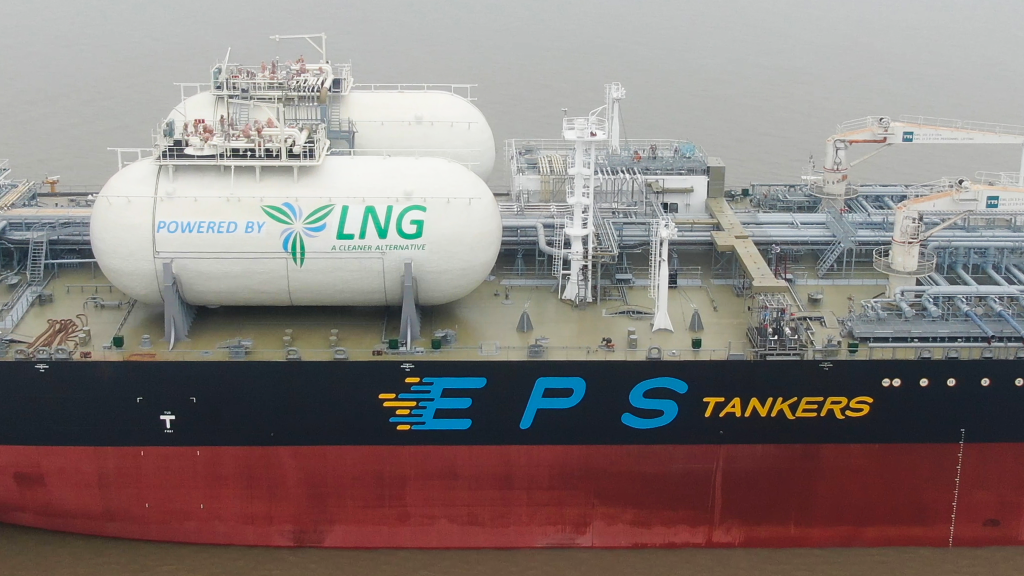
The LNG fuel tanks are positioned on deck to prevent reduction of cargo carrying capacity. Both tanks have their own LNG fuel pump to transfer to a Pump Vaporiser Unit (PVU), which feeds the main engine at a pressure of around 300 bar.
To assist with combustion, a pilot injection is used with minimal quantities of low sulphur marine gas oil (LSMGO). The three generators and two auxiliary boilers are fed by boil-off gas (BOG) from the LNG tanks through low pressure BOG compressors. The auxiliary engines and boilers are also capable of running on distillate, residual fuels, or biofuels/ biodiesel blends.
If the vessel is anchored for more than 15 days, the natural boil-off gas (NBOG) is compressed and supplied to generators and boilers at a controlled pressure of 6 bar to prevent accumulation of pressure in the LNG fuel tanks. There are several safety alarms and trips fitted in accordance with class requirements.
Bunkering of LNG takes longer compared to traditional fuels. In some cases, gassing up and cooling down is required which can take a couple of days, depending on the LNG bunker supply vessel. Safety is paramount when carrying out bunkering operations, with safety measures typically including high level alarms and trips in the bunker tanks as well as emergency shut down devices (ESDs) at the bunker manifold to prevent any leakage.
Both ships will be manned with crew who are fully trained and qualified in the handling of LNG as a marine fuel.
To meet STCW and Flag state requirements, key crew members will sail on board EPS-managed dual fuel ships or gas tankers. During this time, they will gain hands-on experience with BOG management and various associated safety aspects. This will allow them to properly understand the hazards associated with LNG. EPS also provides various classroom, onsite trainings, and virtual reality trainings on LNG Bunkering to these crew members.
Upon successful training and certification, the crew members are assigned to dual-fuel vessels. They will then be guided by shore-based professionals and dual-fuel trainers at every step, from commissioning of the vessel’s gas burning equipment to its first full scale LNG bunkering.

With over 20m dwt under management, EPS is a leading shipping company committed to the green and technology-driven growth of the industry. The company uses a wide range of transitional alternative marine fuels to lower emissions today while simultaneously working with industry peers to develop net-zero solutions for tomorrow.
Find out more about Eastern Pacific Shipping here
With thanks to Captain Anil Singh, Chief Operating Officer.