This is archived. This content was originally published on nepia.com or standard-club.com and will no longer be updated. Please check our live news area for all our latest updates.
Red Sea and Gulf of Aden – Insurance and Charterparty Considerations
Following the recent intensification of hostilities between Israel and Hamas in Gaza, the Iran-backed Yemeni Houthis have been attacking vessels in the Red Sea and Gulf of Aden. In response to a large number of requests from members we have produced this guidance on the insurance and legal aspects of the situation.
P&I cover
Poolable P&I cover for a mutual owner member is not prejudiced solely by a decision to continue a voyage through the Red Sea. The additional risks created by the hostilities and attacks will likely fall to war risk insurance. If the primary layer of this cover is not placed with the Club, it is important that Members speak to their war risks underwriters. War risks are discussed below.
A decision to re-route a vessel to avoid the Red Sea may have serious P&I implications as this may be considered an unjustified deviation, which potentially engages an exclusion to cover. Members should discuss any plan to deviate from the most usual customary or geographical route with the Club at the first opportunity. The impact on cover – and, in particular, whether special insurance needs to be arranged – will be assessed on a case-by-case basis.
Members who are planning to undertake a new voyage through the Red Sea may wish to consider including an appropriate liberty provision in their contract of carriage entitling them to re-route to avoid the area.
Charterparty issues
We are seeing a number of FD&D issues arising from the hostilities and attacks in the Red Sea / Gulf of Aden, both for our Owner and Charterer Members, including whether Owners can refuse Charterers’ instructions to proceed via the Red Sea / Gulf of Aden / Suez Canal, and whether Charterers can place the vessel off-hire and/or claim in damages if Owners decide to deviate the vessel via an alternative route.
The situation is fast evolving and unpredictable. Our Members will need to consider each potential dispute as it arises and on its own merits, looking at the context including charterparty terms, vessel ownership and trading pattern, and carefully assess security risks at the relevant time, along with commercial considerations.
Every charterparty should be reviewed carefully to determine Owners’ and Charterers’ rights and responsibilities when “war risks” arise. Since clauses are often bespoke or amended it is impossible to provide a “one size fits all” answer to the main issues that are arising. However, we commonly see BIMCO’s CONWARTIME and VOYWAR clauses incorporated into time and voyage charterparties respectively.
War Risks include any “actual, threatened or reported: war, act of war, civil war or hostilities…civil commotion…warlike operations…acts of hostility or malicious damage…by any person, body, terrorist or political group, or the government of any state or territory whether recognised or not”.
Under CONWARTIME 2013, Owners can refuse Charterers’ orders to transit a port, place, area or zone, or any waterway or canal (collectively, an “area”), if to do so may, in the reasonable judgment of the Master and/or the Owners, expose the vessel, cargo, crew or other persons on board the vessel to War Risks.
Under VOYWAR 2013, prior to commencement of loading of cargo, Owners may cancel the charterparty or refuse to perform if to do so may, in the reasonable judgment of the Master and/or the Owners, expose the Vessel, cargo, crew or other persons on board the Vessel to War Risks. Owners must first allow the Charterers an opportunity to nominate an alternative safe port for loading or discharging. If the exposure to War Risks arises after commencement of loading of cargo, Owners may give notice to Charterers that a longer route will be taken (and if the total extra distance exceeds 100 miles, Owners may be entitled to additional freight).
The test for determining whether Owners should proceed, or can refuse to proceed, is based on whether an area is dangerous. Owners must be able to evidence that an area may be dangerous, or may become dangerous to the vessel, cargo, crew or other persons on board the vessel.
Owners, in order to establish that a decision has been made in the “reasonable judgment” of the Master/Owners, must carry out their own appropriate and contemporaneous risk assessments ahead of making a decision to invoke charterparty provisions including CONWARTIME and VOYWAR in order to – for example – refuse to follow Charterers’ orders, cancel a charter or deviate. There are a number of resources which can assist Members in this process (see below). We would advise against simply looking at what other Owners/operators have done – the particular situation for each vessel can be very different, and the situation (and therefore the risk profile of the region, and the risk to each vessel) is changing from day to day.
We understand that the nature of our members’ business necessarily demands that decisions are made quickly, and in due course we envisage that it may be necessary (depending on the merits in each case) to determine in arbitration/Court whether these decisions were lawful or unlawful. If Charterers’ orders to transit the Red Sea / Gulf of Aden / Suez Canal are found to be lawful, and Owners’ refusal to follow those orders found to be unlawful, the consequences for Owners including substantial claims in damages for losses suffered, could be significant. It is therefore imperative that our members – both Owners and Charterers – give full consideration to each key issue as it arises, in so far as time and information available allows, before reaching a final decision. Our FD&D lawyers are able to assist you with this process.
As always, we encourage members to engage in commercial discussions where possible, to assist Owners and Charterers in navigating challenging issues such as the present situation in the Red Sea and surrounding areas. Some difficult decisions, and potentially damaging disputes, may be avoidable entirely if the parties discuss their options and reach an amicable agreement at an early stage.
War risks
On the 18 December 2023, the Joint War Committee (JWC) issued an amendment to its listed areas, updating the listed areas for (inter alia) the Indian Ocean, Gulf of Aden, and Southern Red Sea per JWLA-032:
QUOTE
Indian Ocean, Gulf of Aden and Southern Red Sea
The waters enclosed by the following boundaries:
a) on the northwest, by the Red Sea, south of Latitude 18°N
b) on the northeast, from the Yemen border at 16°38.5’N, 53°6.5’E to high seas point 14°55’N, 53°50’E
c) on the east, by a line from high seas point 14°55’N, 53°50’E to high seas point 10°48’N, 60°15’E, thence to high seas point 6°45’S, 48°45’E
d) and on the southwest, by the Somalia border at 1°40’S, 41°34’E, to high seas point 6°45’S, 48°45’E
excepting coastal waters of adjoining territories up to 12 nautical miles offshore unless otherwise provided.
UNQUOTE
The amended areas widen the high-risk zone in the Red Sea to 18 degrees north from 15 degrees north previously.
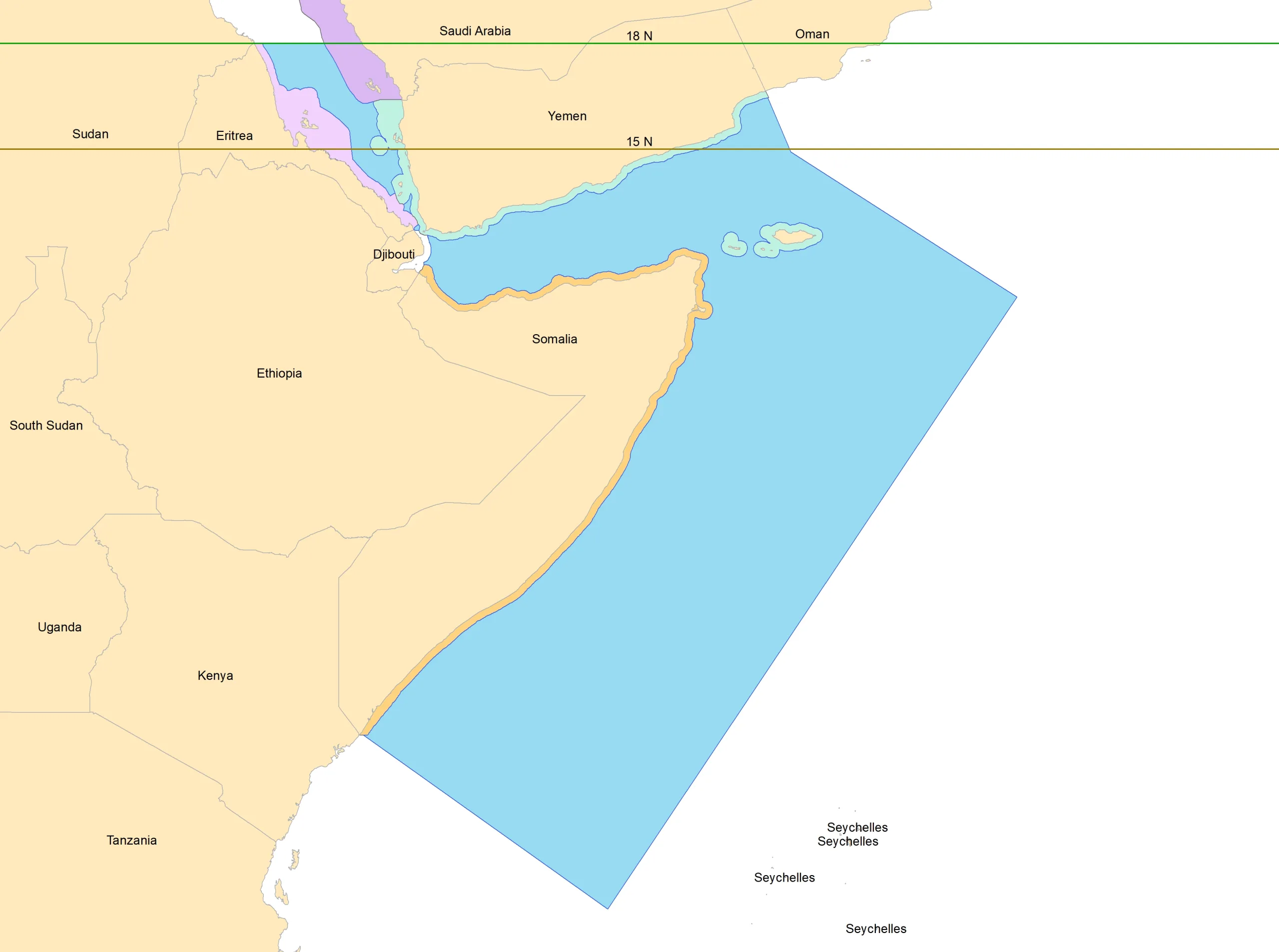
Over the past 6 weeks there have been multiple incidents of vessels approached, attacked, or detained within the Red Sea. Since Houthi rebels began targeting Israeli linked vessels, attacks have focused upon both the striking of vessels with missiles / drones and the attempted or realised boarding of vessels for the purposes of detainment within Yemeni waters. Accordingly, the JWC deems the Red Sea as a high risk after a surge in attacks on commercial ships and to “reflect the missile range”.
War risk rates continue to increase, and thus Members transiting through the revised listed areas should speak with their war risk underwriter(s) before trying to enter or leave any defined additional premium area.
Mutual owners entries
Mutual P&I cover is subject to Rule 24 (North) and Rule 4.3 (Standard) whose provisions, broadly speaking, exclude from cover liabilities, costs or expenses arising from a war. We would consider in any particular incident whether a loss fell within the exclusion but, where it does apply, cover for the loss may alternatively be found in a separate Owner’s war risks policy.
Mutual P&I cover provides an excess layer of cover to a limit of US$500m beyond the amounts recoverable under the greater of either the Entered Ship’s hull and/or war risks policies and any P&I inclusion clauses attached thereto, or the proper value of the ship. The proper value is an amount reasonably close to the equivalent of the free uncommitted market value of the Entered Ship and for the purposes of Club Rules the proper value shall be deemed not to exceed US$500m. NorthStandard may provide the primary war risks cover through an entry in Class 3 (North) or War Risks Class (Standard), or it may have been placed by the owner with another underwriter(s).
So if, for example, a vessel were struck by a missile due to the conflict between Israel, Hamas and, more recently, the Iran-backed Yemeni Houthi’s, and crew on board were killed (or indeed any other P&I liability were incurred), then any legal liability incurred by the Owner in relation to the crew would fall first to war risks cover and not mutual P&I cover.
Members with Class 3 or War Risks Class entries should speak to the Association or their other war risk underwriters before trying to enter or leave any defined additional premium area.
Charterers entries
A charterers entry may contain a War Inclusion Clause (North), a P&I war risks clause (Standard) and/or a War risks clause for additional covers (Standard), which variously cover Members on a primary basis for liabilities, costs and expenses otherwise excluded by Rule 24(1) (North) or Rule 4.3 (Standard) but on additional terms set out in the Certificate of Entry, including the policy limits and deductibles.
The aforementioned clause(s) will have the effect of covering a charterer for P&I and, depending on the terms of entry, Damage to Hull (“DTH”) risks caused by war perils, subject always to the Rules. In addition to setting out exclusions, the additional terms under the aforementioned clauses will define the circumstances in which cover may be terminated automatically or upon notice. At present, this notice period is 72 hours, albeit all war risks cover is automatically terminated on the basis of ‘Five Powers’ outbreak of war.
On 15 February 2024, notice was given of an excluded area in respect of certain covers, including those provided under the clauses mentioned above.
Owners’ fixed premium
Dependent upon members’ terms and conditions of entry – Coastal & Inland Rules (Standard) or Owners’ Fixed Premium Terms and Conditions (North) – cover will usually attach on a “P&I excess” basis (in the same manner as for mutual cover), covering P&I war risks above the policy limits of the insured’s war risks cover or the proper value of the insured ship (whichever is the greater).
Part IV of the OFP T&Cs contain the provision for the club to provide P&I war risks cover on a ground-up basis if agreed between the club and the Insured.
Details of any members’ specific cover may be found in the terms of the certificate of insurance for the relevant insured vessel, where it should be noted that for fixed-premium entries cover will be subject to a policy limit or sub-limit under the Certificate of Insurance arising out of one event, accident or occurrence.
The 15 February 2024 notice of an excluded area in respect of certain covers applies to Owners’ Fixed Premium.
Maritime security – Loss prevention resources
Regional conflicts in the Middle East have raised the security risk to merchant shipping, in particular vessels transiting the Red Sea.
Find out the latest developments in the region with our news alerts:
Following the recent series of threats and attacks, shipping associations BIMCO, ICS, CLIA, IMCA, INTERCARGO, INTERTANKO and OCIMF have come together to publish security guidance applicable to navigating in the Southern Red Sea and Gulf of Aden.
The full guidance is available here >
Security advice, such as BMP 5, can be downloaded from the shipping industry’s Maritime Global Security website >
The United Kingdom Maritime Trade Operations (UKMTO) website maintains a summary of the latest incidents in the region >
Combined Maritime Forces (CMF) Guidance for Shipping Navigating the Southern Red Sea (SRS) >
NorthStandard members have access to our free maritime security loss prevention briefings: